Is it safe to sleep with a heater on?
How we wrote this: AI-assisted research and drafting, checked by editors against the sources listed below. Read our editorial policy and how explainers differ.
As an Amazon Associate I earn from qualifying purchases. Amazon links on this page are marked “(paid link)”. Read the disclosure.
On this page
Quick answer
No. Switch the room heater off before you fall asleep. The US Consumer Product Safety Commission says to turn heaters off when sleeping, and an Indian consumer-affairs columnist writing in The Tribune says never to go to sleep with a heater on. The risk is different by type: heaters that burn gas, kerosene, wood or coal can fill a closed room with carbon monoxide, and electric heaters carry a fire risk. Warm the room first, then rely on blankets.
Who this is for
Anyone in India running a blower, oil-filled, halogen, gas or LPG heater in a bedroom this winter, including families with children or elderly relatives in the room.
The risk depends on the type of heater
Carbon monoxide is the reason fuel heaters are the worst case. The Tribune explains that even a well-built heater in a sealed room slowly uses up the oxygen, combustion becomes incomplete and carbon monoxide builds up. It has no smell or taste and does not irritate the eyes, so you cannot rely on noticing it, and people who are asleep may never wake.
An electric room heater burns nothing, so it does not make carbon monoxide the way a gas heater does. Its danger is fire. The CPSC estimates that portable heaters, including electric ones, are linked to an average of 1,600 fires, 70 deaths and 150 injuries a year in the United States (2020 to 2022 figures). Those are US numbers; we found no comparable Indian figure.
| Heater type | Main risk while you sleep | What the sources say |
|---|---|---|
| Gas, LPG, kerosene, wood or coal heater | Carbon monoxide and falling oxygen in a closed room | The Tribune says unvented fuel heaters should never be used in enclosed spaces with no ventilation, and outdoor gas heaters must never be used indoors. |
| Electric blower, halogen or oil-filled heater | Fire: something falls on it, it tips, or an overloaded plug overheats | The CPSC says to keep it at least three feet from drapes, furniture and bedding, and to plug it straight into a wall socket. |
What to do instead of sleeping with the heater on
- Heat the room before bed. Run the heater for a while with the door shut, then switch it off when you get into bed. This is our practical suggestion, built on the CPSC rule to turn heaters off when sleeping.
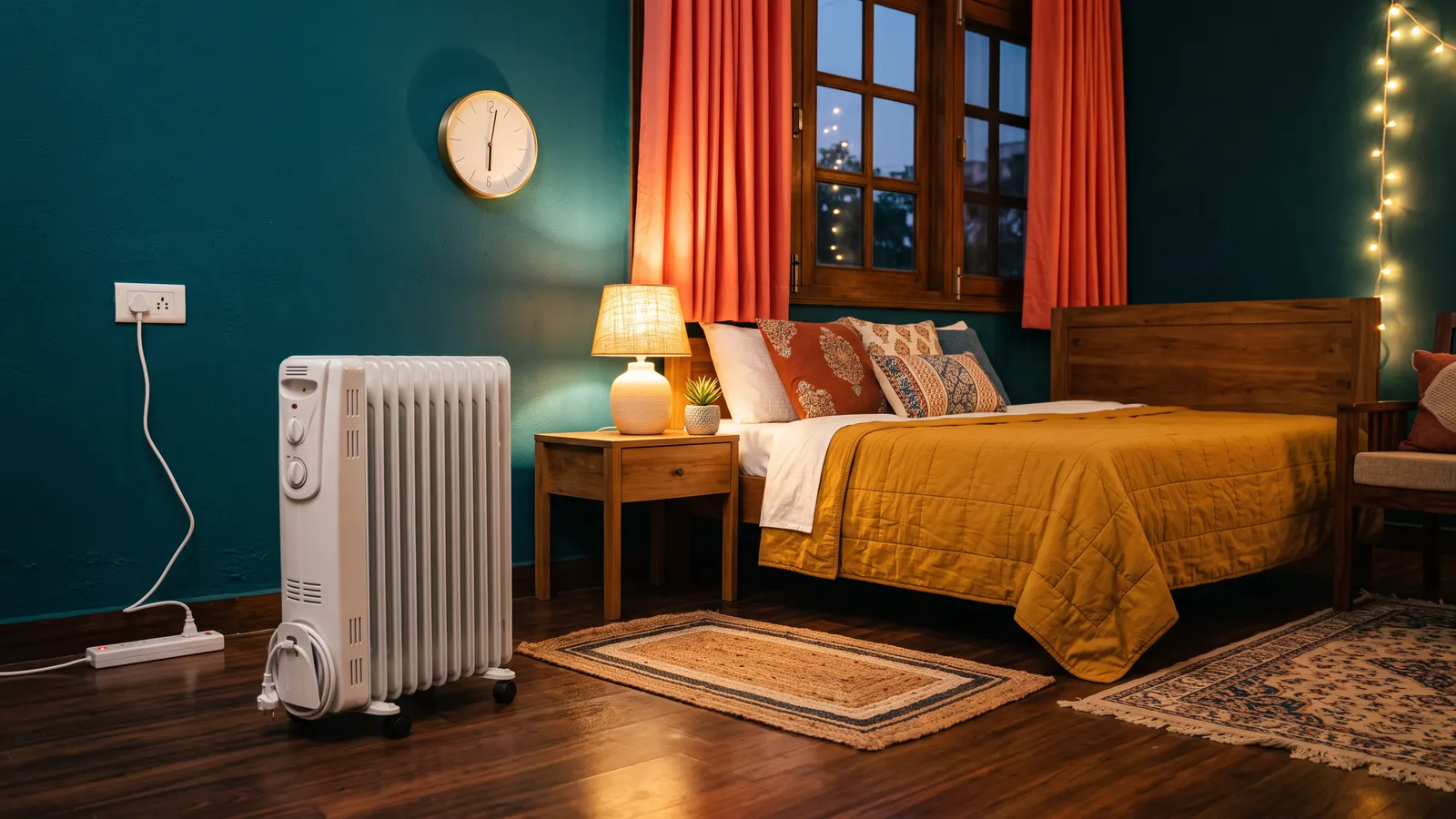
- Keep three feet clear. The CPSC says portable heaters should be at least three feet from drapes, furniture, bedding and other combustible materials. That includes the quilt hanging off the bed.
- Plug into the wall. The CPSC says to plug electric space heaters directly into a wall outlet, never into an extension cord or power strip. Heaters draw a large load: a 2900 W model is about 12.6 A at 230 V.
- Skip fuel heaters indoors. The Tribune’s advice is a good-quality, third-party certified electric room heater. If gas is unavoidable, use a model made for indoor use with an oxygen depletion sensor, keep the room ventilated, and add a carbon monoxide alarm.
- Fit a CO alarm if anything burns fuel. The CPSC says CO alarms should be on every level of the home and outside sleeping areas, battery-operated or with battery backup, and checked every month.
- Layer up instead. Warm bedding and clothes cost nothing to run and carry no heater risk.
What we’d buy for a safer winter bedroom
If you want a heater for evening use before bed, look for the safety features written on the listing: tilt or tip-over protection, overheating cut-off, a thermostat and an Indian safety mark. These are listing claims, not our measurements. They reduce risk when you are awake in the room. They do not make it safe to leave the heater running while you sleep.
- Morphy Richards OFR 13F, 13-fin oil-filled radiator. The listing mentions an adjustable thermostat, safety tilt and auto thermal shut-off, castor wheels and a 2900 W output (2500 W plus a 400 W fan).
- Havells 13-fin oil-filled radiator. The listing says ISI approved and cites the IS 302-2-30 safety standard, with a thermostat, three power settings and a PTC fan.
- Russell Hobbs ROR09F, 9-fin oil-filled radiator. The listing mentions anti-tilt protection, overheat protection, a variable thermostat and a fire-retardant front body at 2400 W.
- Whichever you pick: check the plug point and wiring can take the load, and keep it off carpets and away from bedding.
What we’d buy on Amazon.in
As an Amazon Associate I earn from qualifying purchases.
Frequently asked questions
Is it safe to sleep with an electric room heater on?
The CPSC says to turn heaters off when sleeping, because the main risk is fire from a tipped heater, nearby bedding or an overloaded socket. Warm the room first and switch it off.
Can a room heater cause carbon monoxide poisoning?
Fuel heaters can: gas, kerosene, wood and coal heaters in a closed room, per The Tribune. An electric heater burns no fuel, so carbon monoxide is not its danger.
How far should a heater be from the bed?
The CPSC says at least three feet from drapes, furniture, bedding and other combustible materials. Give a heater more room, not less.
Is a heater with auto shut-off safe to leave on overnight?
The CPSC guidance we read does not say a tilt switch makes sleeping with a heater safe. It still advises turning heaters off when sleeping. Treat shut-offs as a back-up.
Can I plug a room heater into an extension board?
No. The CPSC says to plug electric space heaters directly into a wall outlet, never an extension cord or power strip.
Sources
Checked on . Rules can change, so confirm with the official page before you travel or buy.